
When did you last stop to look at a painting, to take a photo of a beautiful landscape or grab some paints and just let yourself loose on a sheet of paper? A 2017 article in the Guardian noted ‘it’s time we recognise the contributions arts can make to our health and well being.’
Arts and Minds, a leading arts and mental health charity, run weekly art workshops for people experiencing depression, stress or anxiety in Cambridgeshire. Led by an artist and counsellor, it offers a chance to work with a range of materials and techniques, including printmaking and sculpture.
An evaluation revealed a 71% decrease in feelings of anxiety and a 73% fall in depression; 76% of participants said their wellbeing increased and 69% felt more socially included. One participant said “I feel so much better having had the time and space to do some art. It makes such a difference.”
Gavin Clayton, executive director of the charity and one of the founders of the National Alliance for Arts, Health and Wellbeing, says: “Our evidence shows that taking part in creative activities has a positive impact on people’s mental health. The arts are important for wellbeing because beauty has a role in our lives. If we don’t listen to that, or pay attention, then that can cause problems.”
It’s been noted that art can be an important form of expression, it can connect, challenge and inspire us, improving cognitive function too.
‘The arts are a way of forming, shaping and holding in front of your eyes something you feel internally,” says Phil George, chair of Arts Council Wales,
Creative Arts: The Arts for Health and Wellbeing published a report in July 2017 which found that the arts can help keep us well, aid recovery and support longer lives, better lived. The arts also help meet challenges in health and social care associated with ageing, loneliness, long-term conditions and mental health. Crucially they can also help save the care sector money.
This reflects in the fact that mental health services such as MIND and Mental Health UK offer arts based therapies such as painting and creative writing classes as part of their programmes.
The Tate Gallery are currently hosting an online art and wellbeing project which explores how art connects to feelings and wellbeing. The project invites browsers to look at artwork and consider how it makes them feel. There is also a quiz to match your mood to a Tate art work and a series of themed articles on art and other important issues in society.
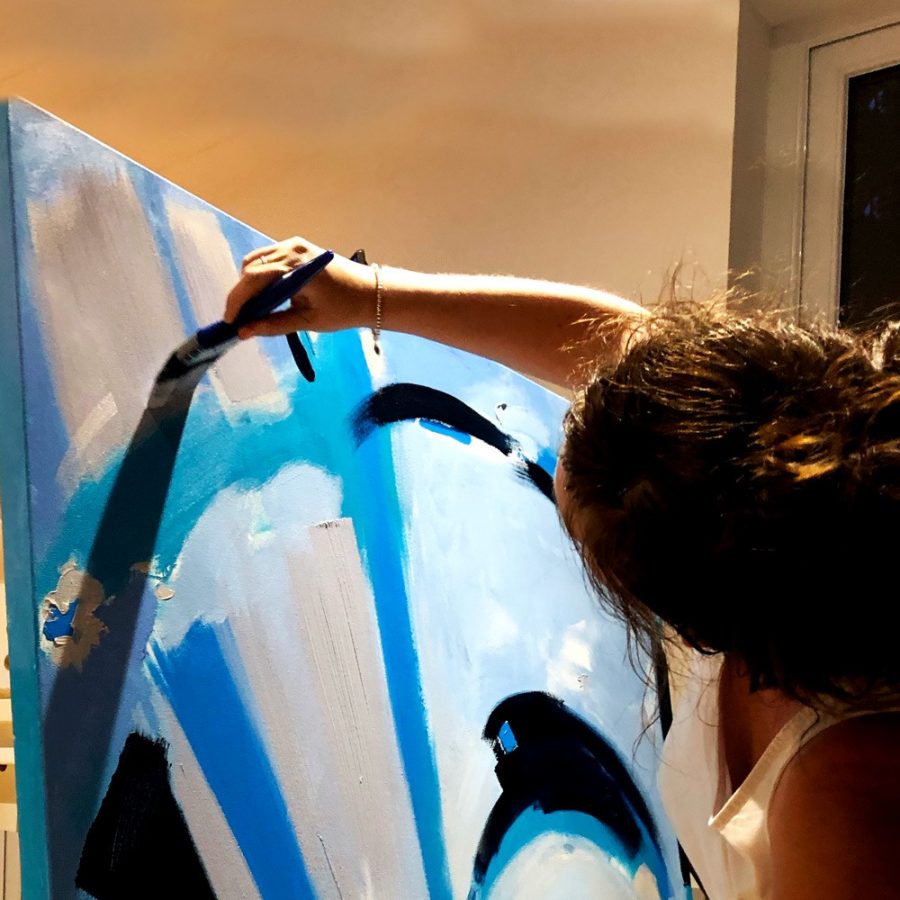
Rachel De Wreede is a Pembrokeshire artist who notes the positive impact the process of creating art and her work itself has had on herself and others.
‘I think creating art and generally being creative is an incredible therapy. It allows you to let loose and express yourself in a physical and tangible way. For me, Painting is an opportunity to shut off my mind from the daily routine and produce work from my subconscious. I find the whole process a great way to release emotion and tension, often feeling lighter and more care-free when finished.
I’ve recently lost my mum who was ill for a long time. When I lost her, I threw myself into the studio and painted every day. I had a solo exhibition to work towards and this gave me the drive to work through so much. I genuinely think having art as my focus helped me through the initial grieving process and hopefully will continue to help me express any feelings of loss and grief.’
Rachel agrees that there should be more focus on art as a therapy and the many ways that art itself, much like other practices, can have a positive influence on our mental health.
‘I feel like Art Therapy is still viewed with a lot of scepticism and undervalued or misunderstood in the general society. As well as the benefits of creating artwork, I feel looking at art can be as therapeutic as listening to music. Staring at a painting for 3 minutes like you would listen to a song can really surprise you and make you feel something new or different. It would be nice to see art therapy more prevalent in communities and given the same level of recognition as the other forms of therapy that are now considered common place.’
In terms of inspiration and therapeutic effect, she mentions her own recent revelations and the way her work has helped others.
‘We recently went to Paris and Monet’s work gave me and my husband tingles, it was so expressive and colourful, it really made us feel something. Feeling anything at all is a sign art helps. I often get people saying they could just stare at my work for ages and they see new colours etc This to me is helping them look inward and maybe discover something holistically about themselves.’
Rachel has been experimenting with art since school and says she is so glad that she chose the path she did. As an artist, graduating with a first degree, she has had many exhibitions and has passed her love of art onto her children who have been drawing, she says, ‘as soon as they could pick up a pencil.’
Rachel works in abstract expressionism and says she likes not having a subject matter for her paintings.
’I create abstract pieces that challenge the viewer to make their own assumptions and reality. Ultimately there are no right or wrong answers – I am trying to make the viewer feel something.’
This feeds into the idea of art as therapy. It’s there to be interpreted, to make the viewer experience something unique to themselves and make sense of the world they live in.
She credits the inspiration for her incredibly beautiful work to her natural surroundings.
‘I am lucky to live in such a naturally beautiful part of the world in Pembrokeshire. Inspiration is all around me all of the time. I find my colour choices have organically synchronised with the changing seasons and the colours they represent. The winter – cool blues and greys. The spring – greens and yellows. The autumn warm oranges and browns. The summer vibrant pinks and turquoise.’

So, if you feel inspired and motivated after reading this, why not pick up a pencil or some paints, head out to take some photographs or to see an exhibition. The arts are waiting for you to explore.
After a successful solo exhibition at the Torch this year, Rachel is currently building a new exhibition. Find out more here.
Find out more about the TATE Gallery’s wellbeing and Art project here.
Deborah Withey offers art therapy sessions one to one or as a group at the Green Shed in Haverfordwest – find out more by emailing – cheesepicklesstudio@gmail.com