
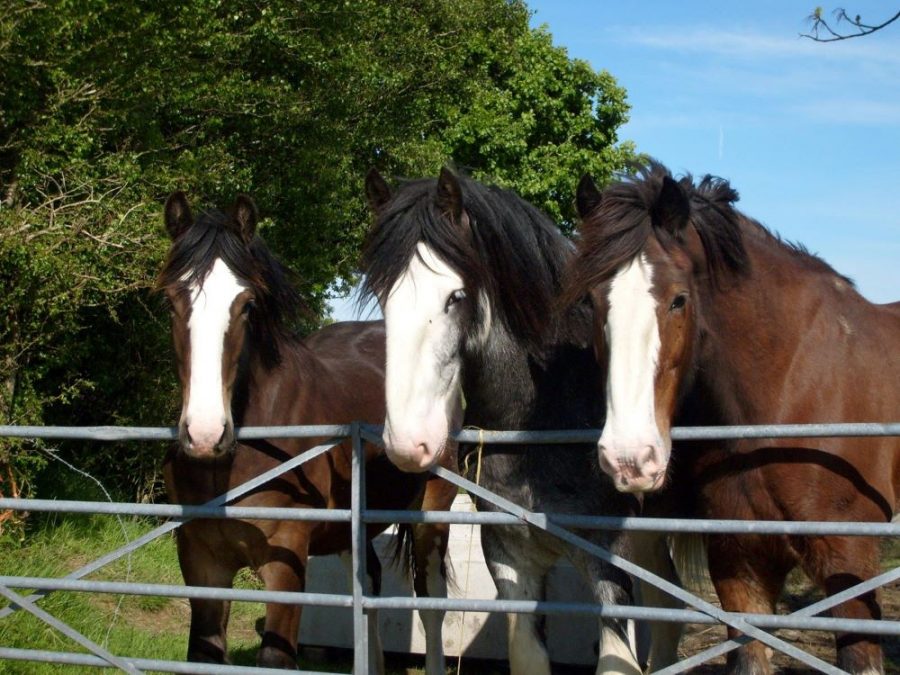
The Dyfed Shire Horse Farm is based in Eglwyswrw on the Pembrokeshire border near Cardigan. After a successful virtual launch in March 2020, it is bringing its selection of animals, including its shire horses, to their virtual viewers this winter.
This family run farm has been in the Lewis family since the 1800’s, its shire horses being used for traditional farming activities such as ploughing and harvesting prior to becoming a tourist attraction in the mid 1990’s.
Mark Cole, a member of the Shire Horse Farm family who helps run the farm’s social media says.
“We wanted to do something. We miss our visitors; they miss the animals. We wanted to reach out to people everywhere. We have over 16,000 followers on Facebook, all these people have an affinity and share a passion for our Shire Horses.
Work on the farm goes on, while everyone around us is standing still. People like to see that the natural world continues.”
During the first national lockdown in March, regular virtual updates with the farm proved extremely popular, reaching not just regular visitors and Facebook followers who missed the interaction with their favourite animals, but enthusiasts as far away as America and Europe.
The farm is the only one in Wales dedicated to Shire Horses, and recently it has become the only approved shire horse centre in Wales, by the Shire Horse Society.
The Lewis family were tenant farmers when they moved to Carnhuan Farm in 1849 and then Mark’s mother Enid was born on the farm. Her father, John Rees Lewis, affectionately known as JR, stands tall in the family history, working and living on the farm throughout his life with his family. All of the family stories have been passed down from JR whose own grandfather Stephen Lewis moved to the farm aged 28 in 1849. Stephen lived to his 103rd year in 1924. Through them both, the story of the family on the farm and of the shires horses in particular, lives on through their descendants.
The farm used shires, as was traditional in the 19th century, to work the land. Mark notes that even through the introduction of tractors to farming around the 1940’s, his family were one of the last in the area to mechanise and accept that the future was tractors and not horses.
‘My grandfather was stubborn. He had grown up as a young man working on the farm with the shires. He broke them in, trained and competed with them, attending agricultural events such as ploughing matches. He was reluctant to change, even despite the fact that Shires are expensive to keep when you’re not using them – they eat 3% of their body weight a day!’
Even up until the 1960’s, JR used horses on the farm as well as a tractor. After this, he retired the horses he had and let them live the rest of their natural lives on the farm.
It was after Mark’s grandfather’s retirement, that the re-birth of the Shire Horse legacy on the farm began. Missing his life with the gentle giants, JR decided to begin his own bloodline breed and he bought two mares, Deborah and Harmony from England – bringing them back to the farm in Eglwyswrw.
The ‘Dyfed’ bloodline, unique to the Shire Horse Farm was created. With the help of his groom Leslie Harrison and Mark’s then teenage elder brothers Huw (now the farm owner) and Paul, JR built a new family of shires on the farm and attend events such as the Royal Welsh Show and the County Show in Haverfordwest during his latter years.
In 1984 he sold his first horse, Dyfed Grey King to America – beginning a new tradition for the Lewis family shires, of equine globe trotters.
When JR Lewis died in 1991 Mark’s parents Enid and Lance did not want to lose the association with the Shires and wanted to preserve them in JR’s memory. They thought about diversifying and decided to open the farm to the public on a trial basis. For one month they opened their gates and this proved a great success. In 1994, after full planning consent was given, they opened officially as the Dyfed Shire Horse Farm.
A decade later, Mark’s father Lance passed away and his mother Enid kept the farm running, with the help of the wider family. Mark’s eldest brother Huw who had helped their grandfather JR with the horses in the 1980s, took over the family business from their mother Enid in 2010 and the venture goes on. ‘Things seemed to come full circle.’ Mark says.
Today, in usual times, the farm offers acres of green countryside with animals including Hereford cattle and their calves, pigs, rare breed Balwen sheep, llamas and donkeys, as well as their incredibly popular shires. There are tractor and trailer rides, land train trailer rides and animals talks and feeds. There is also the popular horse and cart ride, pulled by one of the farm’s very own shires. The agricultural museum on the farm, run by the local CADAMM Society, details the mechanised history of the locality that followed the age of the shire horse on the land. There is also an increasingly popular campsite and on-site café which offers home-made produce for day and overnight visitors.
The Shires, it would seem, have also turned the heads of royalty. Dyfed Grey Celt, who was born in 2005 and whose great-uncle Grey King went to America 20 years earlier, was sold in 2008 to the Household Cavalry in London and became the pride of the family working as a drum horse (earning the highest military title of any animal in the army as ‘Major’ Mercury). He has now performed the Trooping of the Colour 8 times and has performed in countless ceremonial occasions throughout the country and around the world. Dyfed JR, Celt’s younger brother (named after Mark’s grandfather), was chosen in 2017 to train as a drum horse for the Sultan of Oman. Ed, the farm’s popular 4-year-old gelding, used to pull the cart for the horse and cart ride around the farm. Then in late 2019, he was sold for training as a second drum horse to the Household Cavalry.
This connection with Royalty continued, as on 3rd July 2018, Prince Charles and Camilla the Duchess of Cornwall accepted an invitation from the family to visit the Dyfed Shire Horse Farm to see where the royal shires had come from and the efforts made to preserve this rare breed. Camilla initially accepted, but just 6 days prior to the visit, Prince Charles notified everyone that he would be coming too. This was much to the pleasure of the family and of the local community, who were invited to this most special of days in the farm’s history.
Following this new connection to London, HM the Queen agreed to name a foal born on her birthday on 21st April 2020, following suggestions that she be invited to do so on the Shire Horse Farm’s Facebook page. From a shortlist offered to her by the family, HM the Queen chose the name ‘Guinevere’ – following on nicely to the theme of shire names from the Arthurian legend. Previous horses on the farm had been named ‘Lancelot’, ‘Merlin’ and ‘Morgana’.
Of course, the visitor’s interaction with the animals has a well-being aspect, which is extremely important. There have been some very touching moments, as Mark describes,
“We have many groups coming to the farm. Some of the senior groups have members who are in homes or sheltered accommodation, they may have memory problems or disabilities that affect their day-to-day life. Often, they come alive when they see the animals. Memories for them are important. Often their carers say that they have since opened up in ways they never have before.”
Mark also says that the impact on families and children has been great too,
“Some parents, with children who have learning disabilities, or conditions such as ADHD, say that the shire horses calm them. They say how lovely it is to see their child calm and quiet. Something about these huge animals that are so gentle, really relaxes them. There’s a lot to be said for wellbeing and animals, how a big majestic creature can be gentle and calm, creating a calming influence.”
Mark notes the impact of green spaces too, “The countryside can be a calmer place.”
One of the regular visitors to their campsite, have called the Shire Horse Farm and its idyllic surroundings their ‘happy place’ – something which the family are pleased to hear as they pride themselves on providing a relaxed and welcoming atmosphere. Mark explains,
“We’re a quiet, laid back family farm. People can learn the history and step back in time. There’s the company of the animals and learning about them. People who come regularly get to know their characters and develop a bond with each and every one.”
This is why, it seems, the virtual connection is so important,
“We want to use technology for good – to reach out to people, particularly in remote, solitary areas. Winter is a glum time and the weather is not the most uplifting at the best of times and there’s all the guidance because of the virus. We want to keep in touch and offer some continuity, something for people to connect with and look forward too. If people have the ability to look beyond their own four walls, we hope their well-being can be improved.”
Catch adventures on the farm every Tuesday (weather permitting) on Facebook – find out more here.