
One of the most important values that we crave as human beings is the act of communication and connection. With the influx of social media and video calling apps such as WhatsApp and Facetime, it’s never been easier to keep in touch.
These platforms and facilities have proved to be a godsend during the harsh realities of lockdown. Yet, many have turned to an age-old art of connection, finding the joy of hand writing letters to family and loved ones.
When I was growing up as a teenager in the late 90’s, pen pals were the current craze. I spent hours of my spare time writing to friends across the UK, some as far away as Scotland and East Anglia. I remember the handwritten booklets, with people’s details in bright coloured felt pen, as well as their hobbies and interests. I suppose this was the beginning of a kind of social media.
When my sister studied abroad for a year as part of a language degree, we wrote to each other, and I still have the letters in a box in my cupboard.
My best friend, whom I have known since I was 3 years old, used to write to me even though we only lived across town, sometimes exchanging handwritten letters during the school day, to pass time when we were in separate lessons. She now lives in Bristol, and we still send each other letters and cards, more frequently since lockdowns have prevented us from visiting each other.
So, for me and my generation, this method of communication is not unfamiliar. In a way, it has always been my preferred method of connection when face to face contact is not possible.
Although, since the rise of email and texting, as well as the heavy use of social media, it seems that the younger generations are missing out on something that was part of everyday life for some.
In 2010 the Guardian reported that a fifth of children had never received a handwritten letter. The report was commissioned for Children’s Charity World Vision. They also reported that with young people increasingly relying on email and social networking sites to communicate, a tenth had never written a letter themselves.
Child education expert Sue Palmer, the author of ‘Toxic Childhood’, said,
“If children do not write or receive letters, they miss out on key developmental benefits. Handwritten letters are much more personal than electronic communication. By going to the trouble of physically committing words to paper, the writer shows their investment of time and effort in a relationship. That’s why we tend to hang on to personal letters as keepsakes.
The effort of writing is a very real one for a child. Painstakingly manoeuvring the pencil across the page, thinking of the best words to convey a message, struggling with spelling and punctuation. It is, however, an effort worth making, because it’s only through practice that we become truly literate – and literacy is a hallmark of human civilisation.”
Of course, letter writing has become a lost art, because of the far easier and faster ways of contacting people. We now have email and texts, as well as social media platforms to keep in touch and getting a response instantly, so that letters have become known as ‘snail mail’ (since 1999) due to the length of time to reach the recipient.
In the past, hand written letters were a necessity as the only form of communication between one person and another. They were written and then posted. Often taking days or weeks to arrive at their destination. Even urgent news was carried by letter. Many classic novels tell of the perils of an ill-fated letter failing to arrive on time, or being misplaced, leading to dire consequences. In Thomas Hardy’s Tess of the D’Urbervilles, Tess discovers that her letter has not been delivered under the door to the room of her husband to be, confessing all of her sins before they are to be married. It has slipped under the carpet, never to be seen or opened. She has married Angel Clare, with him being unaware of who she really is.
Since the country went into lockdown, due to the Covid-19 pandemic, it seems that letter writing has been on the rise, perhaps people opting for a more personal method of communication, and one closest to actual human contact.
In May 2020, a BBC article called letter writing ‘connection for disconnected times’ and they noted that the writer Lionel Shriver said that ‘Zoom just doesn’t cut it’ when talking about communicating with friends and family during the lockdown. As the lockdown was introduced in the Republic of Ireland in late March 2020, the postal service, An Post, sent each household two free stamps and postcards to encourage people to write to each other. It has since reported an increase in non-business, person-to-person mail.
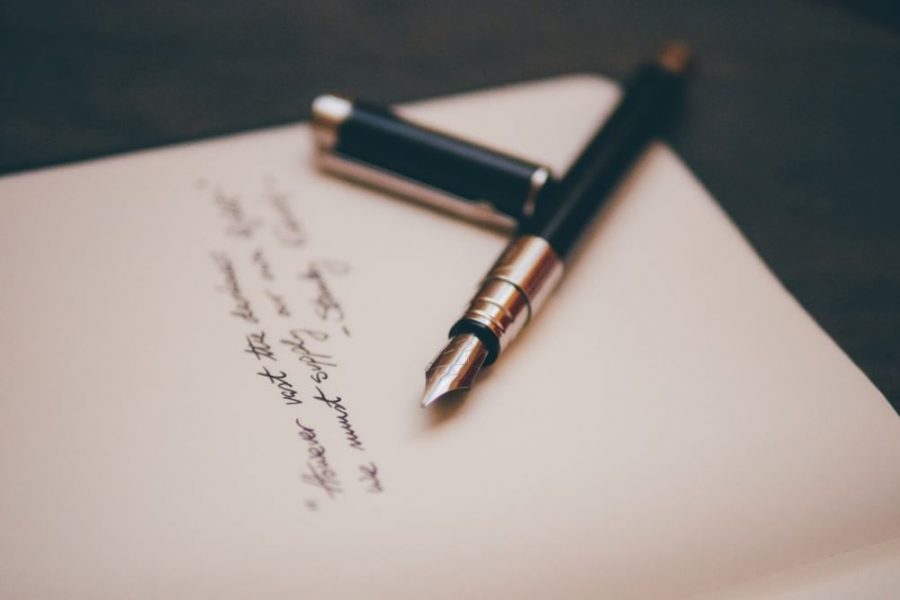
It seems time and opportunity has allowed us to explore the benefits of letter writing. There is a slow and meditative quality to hand writing a letter. The practice of choosing stationary and a pen, a quiet and clear space to work. The process of using your hand to write, can also flex unused muscles. It leaves time for thinking and concentrating. There is also a finality in the words used, as fresh ink cannot be erased like a line of an email or a word in a text. For the receiver, of course, there is something special about a handwritten letter. It is something far more personal and significant than a text or email.
Of course, letters are a great form of communication and connection for all of us, but they are also a lifeline for many.
In December Life Seeker wrote about Letters to the homeless. The Wallich, a charity dedicated to helping the homeless get off the streets and access opportunities, created the Letters Against Loneliness campaign. Started in response to the Coronavirus pandemic, the initiative aims to help people facing the challenges of homelessness feel less isolated. The focus is even more poignant, as a homeless person would not have access to the services that most of us take for granted, such as mobile phones and computers. A handwritten letter from a kind stranger may be the only form of communication they have.
10-year-old Libby Scott from Pembrokeshire was praised on Good Morning Britain, for writing letters to nursing home residents during the lockdown, as part of their 1 million minutes campaign, while People Speak Up, a charity based in Llanelli, are also running a letters of kindness project. The project involved volunteers writing creative letters to people in care homes or living alone.
It seems that the seemingly lost art of letter writing is even cropping up in the most unlikely of places. Aberystwyth Library have set up the Seaside Library, a book borrowing and exchange scheme on the seafront, with the option to hand write a letter to a librarian, which will in turn prompt a reply to the sender. All they ask for is the writer’s contact details and some information about their hobbies and the books they like to read, prompting a conversation in the age-old method of communication and a more personal experience
Letters are also something that can be treasured and kept for years to come. As well as a document to world events, such as the Covid-19 pandemic. So, perhaps now has never been a more important time to document our thoughts and feelings, sharing them with our loved ones.
Artist and performer, Becka Mcfadden, used letters discovered during the national lockdown, as a basis for a performance installation called Letters of the Present Wars in collaboration with Beautiful Confusion Collective. The letters were written by her Grandparents during World War 2, and they shed light on a period of history, which Becka found paralleled the world she was currently living in.
“Discovering these letters by accident, in my mother’s garage, I began reading and re-reading them at a time when I found myself increasingly distressed and anxious about current geopolitical events – Brexit, Trump, climate change, and now COVID-19 – all communicated via a relentless 24-hour news cycle. In this project, I look to the letters for historical perspective and insight into what it was like to live in a time of global conflict. At the same time, and on a more personal level, the discovery of the letters brought me into close contact with my grandparents’ relationship, and the bold decisions of their youth that sometimes feel irreconcilable with the adults I knew.”
The production was part of the Living Record Festival, showcased during 17th January – 22nd February. Viewers can gain access to the digital archive and the e-gallery as well as the individual pieces here.
If, after all this you are still considering if snail mail is really for you, Martha Stewart.com suggests 7 reasons why we should revive the lost art of letter writing.
– Handwritten letters are personal – the thought that goes into them, the words that are used, try slipping a small handmade gift or photograph inside the envelope.
– Handwriting is a stress reliever – giving us time to ourselves to think, to communicate with loved ones and open up our hearts and share feelings.
– It’s an opportunity for creativity and self-expression – try using different coloured stationary and a variety of pens.
– Handwritten letters provide you the gift of time – In a fast-paced world writing a letter gives us the opportunity to slow down, to relax and take things into account. It also takes your eyes of the screen and engages your brain in a new way.
– You can build relationships and further connect with people – sharing a letter with someone provides an element of a deeper connection.
– They have more value than a digital letter – handwritten letters are far more personal. The receiver can touch them, smell them, share them and they can be kept and treasured.
– Letters are historical artefacts – We would have no record of past events or generations of our family if we didn’t have hand written records of their lives and experiences.
Letter writing is free (aside from the cost of a stamp), takes minimal time and can contribute to health and well-being. So, pick up that pen, and write a letter to someone. Think of the joy it will bring you both.
Find out more about Letters against loneliness here and People Speak up here.
Find out more about the seaside library ‘write a letter to a librarian’ project by emailing Worldstoriesinfo@gmail.com or find more details on Aberystwyth sea front.